
Connecting production completion to ocean shipment milestones
A scheduled completion date only says when manufacturing is currently expected to finish. Quality, packing, empty pickup, stuffing, documentation, customs, gate-in, and actual departure each have their own status, source, and deadline.
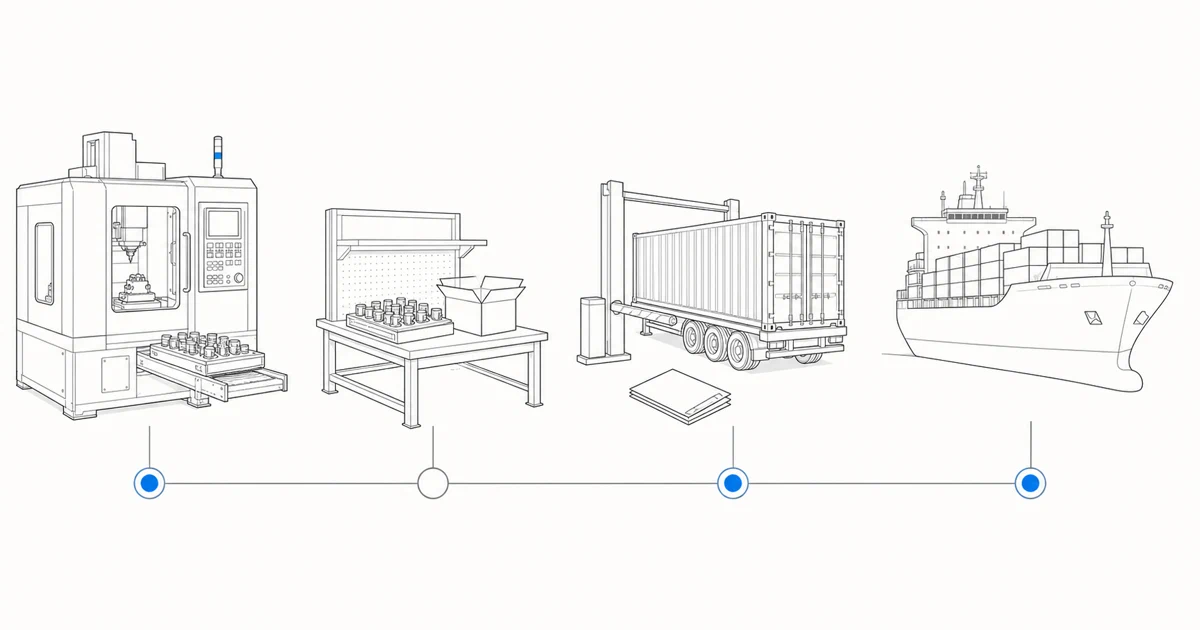
Production completion is not shipment readiness
Record planned completion, actual completion, and shipment readiness separately. Planned completion comes from the current schedule, while actual completion comes from an accepted production report. Shipment readiness is an internal control defined by the manufacturer, including quantity, applicable quality and post-processing, packing and labels, handoff location, and required source data.
Microsoft's production lifecycle separates scheduling, Released, Reported as finished, quality assessment, and put-away or shipment. It shows that quality and warehouse work can remain after production reporting, but it does not prescribe one status model for every factory. Partial reported quantity should not be described as the whole order being ready.
Kavop's most mature current scope remains production scheduling and order due-date analysis. This guide explains how to review production milestones beside externally sourced shipment milestones. It does not turn an internal plan date into evidence of booking, gate-in, or vessel loading.
Back-plan readiness from the latest confirmed milestones
Do not subtract a fixed number of days from ETD. First identify FCL or LCL, inland-haulage responsibility, and the stuffing or handoff location. Then extract empty-container pickup, earliest full-container delivery, Shipping Instructions, Verified Gross Mass, CY, CFS, and other applicable cut-offs from the latest booking confirmation and formal notices.
Each external milestone needs a location, time zone, source document, version, received time, and last review. Production can then back-plan quality, packing, labels, warehouse handoff, inland movement, and locally approved exception buffers. A buffer comes from real travel, operating windows, and risk, not from one universal number of days.
DCSA defines separate cut-off codes for equipment pickup, earliest full-container delivery, documentation, VGM, FCL, and LCL handoff. Carriers and terminals can update cut-offs with the schedule, so an example webpage, an old email, or experience from another shipment should not override the latest confirmation or notice.
Separate booking request, confirmation, and amendment
A booking request provides origin, destination, cargo, equipment, quantity, expected readiness, and a requested schedule. DCSA Booking guidance says that a 202 Accepted response only means the request entered processing. Received, confirmed, declined, and amendment states remain distinct.
Keep the request reference separate from the carrier booking reference, together with status, confirmation version, routing, equipment, vessel and voyage, cut-offs, and latest amendment. Maersk's public workflow also separates schedule selection, submission, and later confirmation, but that is a carrier-specific process rather than a universal contract term.
A booking confirmation does not prove production completion, empty pickup, laden gate-in, loading, or departure on the original vessel. A change to production quantity, equipment, voyage, routing, or cut-offs requires a retained version and another review of affected factory and shipment milestones.
Connect empty pickup, stuffing, and laden handoff
An FCL flow commonly records the earliest empty pickup, depot, planned and actual pickup, container number, and equipment interchange receipt. After applicable quality, packing, and labeling checks, it records stuffing start, completion, seal, and laden-container handoff. Pickup availability means an equipment window exists, not that the empty has reached the factory.
Maersk's public guidance illustrates booking confirmation, empty pickup, equipment interchange, stuffing and sealing, and laden handoff as separate steps. Whether a shipper, forwarder, warehouse, haulier, or container freight station performs them depends on service type, haulage, contract, and local rules.
LCL cargo handed to a Container Freight Station follows a different model, so FCL milestones cannot be copied unchanged. The team needs to define the quantity and packing the factory hands over, the location and receiving party, and the receipt or manually confirmed event that links the handoff to the manufacturing order.
Manage SI, VGM, customs, and cut-offs separately
Shipping Instructions are an important input for carrier transport documents and commonly add parties, cargo description, packages, volume, and weight to the booking. They are not export customs documents and cannot be replaced by stuffing completion or VGM. Changes to parties, cargo, packages, weight, container, or seal should trigger another SI and transport-document review.
Verified Gross Mass includes the packed cargo, packaging and securing material, and container tare. IMO says the SOLAS-defined shipper is responsible for obtaining and providing VGM in time for vessel and terminal stowage planning. VGM is one condition for loading, but it does not create a right to load or prove loading or departure.
A single customs cut-off label can hide a broker document deadline, carrier filing milestone, SI, VGM, dangerous-goods, reefer, CY, or CFS cut-off. China export flows also distinguish cargo declaration, electronic container-packing-list data in the manifest process, advance manifest, arrival report, customs release, and load manifest. Qualified customs parties and the competent customs office need to confirm the applicable requirements; this guide is not shipment-specific legal or customs advice.
Separate gate-in, estimated times, and actual events
A CY or CFS cut-off is the latest delivery milestone for a requested schedule, while gate-in is the actual entry of a container into a controlled facility. Timely laden gate-in does not by itself prove customs release, load-list inclusion, vessel loading, or departure.
DCSA separates estimated, planned, and actual times. ETD and ETA are estimates that can change with operations. ATD and ATA record completed departure or arrival events at a defined location. Each timestamp needs a port or terminal, vessel and voyage, leg, time zone, source, and update time.
ATA at the destination port does not mean discharge, cargo release, pickup, or customer delivery. For a transshipment, keep estimated and actual arrival, discharge, connection, loading, and departure milestones for each leg. After a roll, vessel change, port omission, or routing change, recheck every later connection and the final ETA rather than treating the old values as current.
Recheck linked order and shipment milestones after every material change
When production finishes later or yields fewer conforming units, recheck readiness, stuffing, SI package and weight data, VGM, customs material, CY or CFS cut-offs, and split or rebooking options. After a change to equipment type or quantity, container number, or seal, review booking, VGM, documents, manifest links, and terminal records according to the field that changed rather than assuming every record is synchronized.
After a vessel, voyage, ETD, port of loading, or routing change, extract the cut-offs again and review pickup and return arrangements, customs or manifest steps, transshipment connections, and final ETA. Preserve the old value, new value, source, received time, affected milestones, owner, and review result instead of silently overwriting the prior version.
Sales, planning, quality, warehouse, order follow-up, forwarders, customs parties, carriers, and terminals each own part of the evidence. An internal review can surface the owner and action. Booking, documentation, declaration, appointment, and transport work still occurs through the authorized party and system of record.
Run a read-only linkage pilot on one order set
A first round can select one de-identified order set, fix the production data cutoff and schedule version, and then assemble booking confirmations, forwarder or carrier updates, terminal receipts, and manually reconciled actual events. Each value retains its source and version, while production and shipment baselines remain unchanged by the candidate review.
The team reviews the margin between planned completion, actual completion, shipment readiness, and the latest cut-offs order by order. It also identifies missing evidence across booking, pickup and stuffing, SI, VGM, customs, gate-in, and ocean-schedule milestones. The review sheet shows differences and items to verify, while designated owners return to the source systems to act.
Kavop is not currently positioned as a provider of real-time ocean schedules, AIS data, container tracking, automatic booking, customs filing, VGM submission, terminal appointments, or freight forwarding. This is a read-only linkage method for seeing which production change reaches which shipment milestone. It does not guarantee loading on the original vessel, on-time departure, or customer delivery.
Sources
These official sources distinguish production completion, booking, equipment, documentation, VGM, customs, cut-offs, and transport events. Carrier pages illustrate carrier-specific processes; inclusion of these sources does not imply endorsement of Kavop.
- Microsoft Learn production process overview
- DCSA Industry Blueprint 2026 Q1
- DCSA Booking technical implementation guidelines
- DCSA Bill of Lading 3.0 introduction
- DCSA cut-off time code information model
- DCSA shipping glossary
- DCSA Track and Trace standard documentation
- DCSA Commercial Schedules
- DCSA Operational Vessel Schedules documentation
- DCSA VGM 1.0.0 purpose and scope
- IMO verified gross mass guidance
- China Customs cargo declaration service guide
- China Customs manifest management service guide
- Maersk Greater China operation deadline guide
- Maersk Vietnam export guidance
- Maersk guidance on rollable cargo, cancellations, and amendments
Review completion, readiness, and shipment milestones for one order set.
The first round uses read-only inputs. Ocean schedules, booking, customs, and terminal states remain governed by authoritative external sources. Shipment milestones retain their source and update time so the team can review the latest progress.