
How manufacturers make feasible delivery promises
When a customer asks for delivery by month-end, sales first needs to clarify whether that means factory shipment or customer receipt. Quantity, material, occupied capacity, and existing orders then need review. A schedule can provide candidate dates, while an authorized owner decides what the manufacturer will promise.
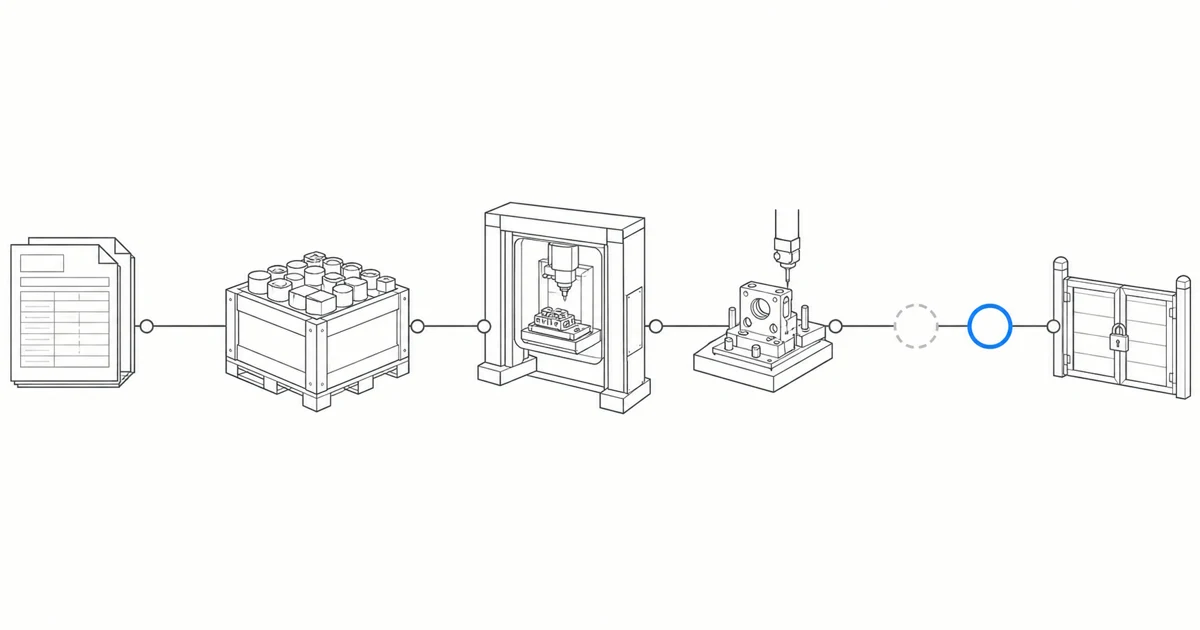
Separate requested, feasible candidate, and authorized promise dates
A request for delivery by month-end may mean shipment from the factory or receipt at the customer's warehouse. Packaging, warehouse handling, and transport sit between those events. Order review should record the product, quantity, ship or arrival milestone, locations, time zone, split rule, and the date range the customer can accept.
Official documentation from Microsoft, SAP, and Oracle distinguishes a requested date from calculated or confirmed dates. The products use terms such as requested, expected, scheduled, confirmed, and promised for different fields. They should not all be collapsed into one delivery date, and a populated order field does not by itself show that the business has authorized a customer commitment.
This guide uses three practical layers. The requested date records what the customer wants and at which milestone. A feasible candidate date records what the current inputs and rules calculate. An authorized promise records the date and quantity the manufacturer has agreed to communicate. Every response should identify whether it refers to shipment or arrival.
Choose the depth of check that the order requires
A fixed sales lead time can support an initial screen. Microsoft also documents that this method uses a default number of days without considering inventory availability, known demand, or planned supply. A manufacturing order constrained by material or capacity needs a deeper check.
ATP and CTP help explain two levels of assessment. Microsoft ATP considers uncommitted inventory, planned receipts, and existing demand while assuming infinite resource capacity; its CTP adds material and production capacity. SAP documents Supply Creation-Based Confirmation (SBC), while Oracle Global Order Promising has its own promising rules. Their names, configurations, and algorithms are not interchangeable.
For a stocked item, current and planned supply may support an availability check. A make-to-order or replenishment case also needs component supply, routings, finite resources, and transport time. ATP and CTP are industry concepts in this guide, not substantiated Kavop product modules.
Give every material decision a data cutoff
A material check brings together available inventory, reservations, planned receipts, purchases and inbound supply, demand from existing orders, and the earliest availability of critical components. Book inventory states what the system records. It does not establish that every unit remains assignable to the new order.
SAP availability checks account for current and planned supply together with concurrent orders. Oracle promising also depends on collected or directly supplied demand, supply, and rule data. In both cases, a material conclusion needs a data cutoff, defined scope, and supply status. Yesterday's export does not automatically represent today's availability.
Substitute material, an earlier supply date, or a temporary transfer can remain a candidate condition only when its data is credible and the relevant engineering, quality, purchasing, or customer authority exists. If evidence is missing, record the shortage and open condition instead of treating the proposed supply as available.
Calculate finite capacity with existing orders in scope
When new production is required, routings, processing times, resource calendars, occupied load, shifts, and downtime can move the candidate date. Microsoft documents that finite capacity must be enabled for the plan and relevant resources before reserved capacity is considered. Insufficient capacity can push a date out.
A new order should not be given an isolated theoretical slot. It competes with existing orders for the same materials, machines, and time. The review should add the new demand to the same planning scope and identify existing orders that move earlier or later, supply or resource relationships that change, and released or started work that would need an exception.
A finite-capacity result covers only constraints modeled and included in the run. Labor, tooling, maintenance, changeovers, or subcontract capacity cannot influence the result when their data and rules are absent. Keep unmodeled conditions beside the candidate date so a planner can judge whether they change the answer.
Carry production feasibility through to customer receipt
After components are ready, an order may still need production, inspection, post-processing, packing, and warehouse release. Pickup, transport, and customer receipt follow. Microsoft documents how vendor, warehouse, transport, and customer calendars affect planned dates. Oracle also separates expected shipment and arrival milestones.
A projected production completion date therefore cannot be copied directly into a customer-arrival promise. The manufacturer must add verified post-processing and transport time and check whether the relevant calendars are open. A customer request tied to a sailing or port milestone also needs a separate review of booking, cutoff, and ocean-shipment conditions.
Kavop's current scope in this guide is production-side due-date feasibility. Ocean shipment belongs to the same long-term order path, but a production schedule must not be presented as an automatically calculated sailing or customer-receipt commitment.
Prepare candidate responses that sales can explain
Order review commonly produces a few basic responses. Confirm the requested milestone and quantity when the request is feasible. If the customer allows a split, state the quantity and date of each part. If the full quantity needs more time, offer a complete-order candidate date. If critical data or authority is missing, keep the order uncommitted.
Each candidate version should use the same data cutoff and state its assumptions. Overtime, subcontracting, alternate resources, substitute materials, split delivery, and transport changes belong in a version only when supporting data and authorization exist. A calculable option is not yet an operating decision.
A useful comparison records the requested date, candidate ship or arrival date, confirmable quantity, critical materials, constrained resources, affected existing orders, protected near-term work, and unresolved risk. Sales can then see how the date was derived and which change should trigger another review.
Recheck the promise when quantity or constraints change
A candidate date can become stale after a change to quantity, site, material, lead time, reservation, calendar, or supply date. Microsoft standard CTP and Batch CTP differ in their recalculation timing and status behavior. Oracle also documents an Override Schedule attribute that can prevent later quantity or requested-date changes from triggering rescheduling. A date that remains visible on screen is not evidence that it remains valid.
Define review triggers in advance. Which field changes invalidate the earlier result? Who starts the review? What difference between the external promise and the new candidate needs escalation? Who informs the customer and shop floor? An earlier candidate also needs review because the customer may have an earliest receiving date and operations may incur a new handling burden.
A Kavop first round can use one anonymized order set from a stated cutoff for a read-only review of the current schedule and candidate options. It makes no automatic write-back to production systems and does not demonstrate real-time inventory, automatic promising, or bidirectional ERP and CRM synchronization. First make the date basis, impact, and human approval reviewable, then decide how the next integration step should work.
Sources
The guide draws on the following official documentation for requested dates, availability checks, finite capacity, calendars, order confirmation, and change review. Product terminology and configuration differ, while Kavop's current scope follows the read-only scheduling validation described on this site.
- Microsoft Learn on order promising
- Microsoft Learn on calculating sales-order delivery dates with CTP
- Microsoft Learn on finite capacity planning and scheduling
- Microsoft Learn master plans overview
- Microsoft Learn on calendars and master planning
- Microsoft Learn on confirming sales orders
- SAP Advanced Available-to-Promise
- SAP supply creation-based confirmation in PP/DS
- SAP review of availability check results
- SAP planning time fence
- Oracle Global Order Promising overview
- Oracle availability dates
- Oracle promised ship and arrival dates
- Siemens Opcenter capable-to-promise capabilities
Put one real order set beside the customer's requested date and test the production candidate.
Use anonymized orders, routings, resources, and material data from the same cutoff for a read-only due-date review, then let an authorized owner decide which date the manufacturer will communicate. Findings from one sample cannot be extrapolated to the whole plant. File or snapshot intake does not establish real-time synchronization, bidirectional integration, conflict handling, or production-system write-back. Current public material does not establish complete Kavop logic for inventory, reservations, supply, demand, shortages, and substitute-material availability.